Building a neighbourhood around fine craft and artisan trades
Once again this year, Héritage Montréal’s Next Generation Committee (CoRe) invited students and emerging professionals to reflect on the future of the industrial heritage of the Bridge-Bonaventure sector, located in the borough of Le Sud-Ouest in Montréal. For this fourth edition, CoRe presented a new version of its ideation charrette, expanded with two new components. First, it broadened the scale of urban intervention while inviting participants to consider the requalification and adaptation of industrial buildings. Second, this was the first edition organized in collaboration with the Conseil des métiers d’art du Québec (CMAQ), with the goal of imagining a meaningful project for the sector.
Long before colonial settlement, First Nations used the land that would become the Bridge-Bonaventure sector for transportation and trade. Its proximity to the St. Lawrence River and the Lachine Canal made it home to many port and manufacturing industries from the 19th century onward. Montréal’s deindustrialization and the closure of the Lachine Canal in 1970 led to the sector’s decline and the closure of several businesses. Beginning in the 1980s, artisans’ workshops moved into the area. Today, rising property pressures, a shortage of production space and a lack of premises suited to heavy, specialized equipment make it difficult for artisans to stay and for new workshops to set up.
Since 2019, the CMAQ and its members have been championing the Fine Craft and Artisan Trades District project to create a lasting home for creation, production and the transmission of know-how.
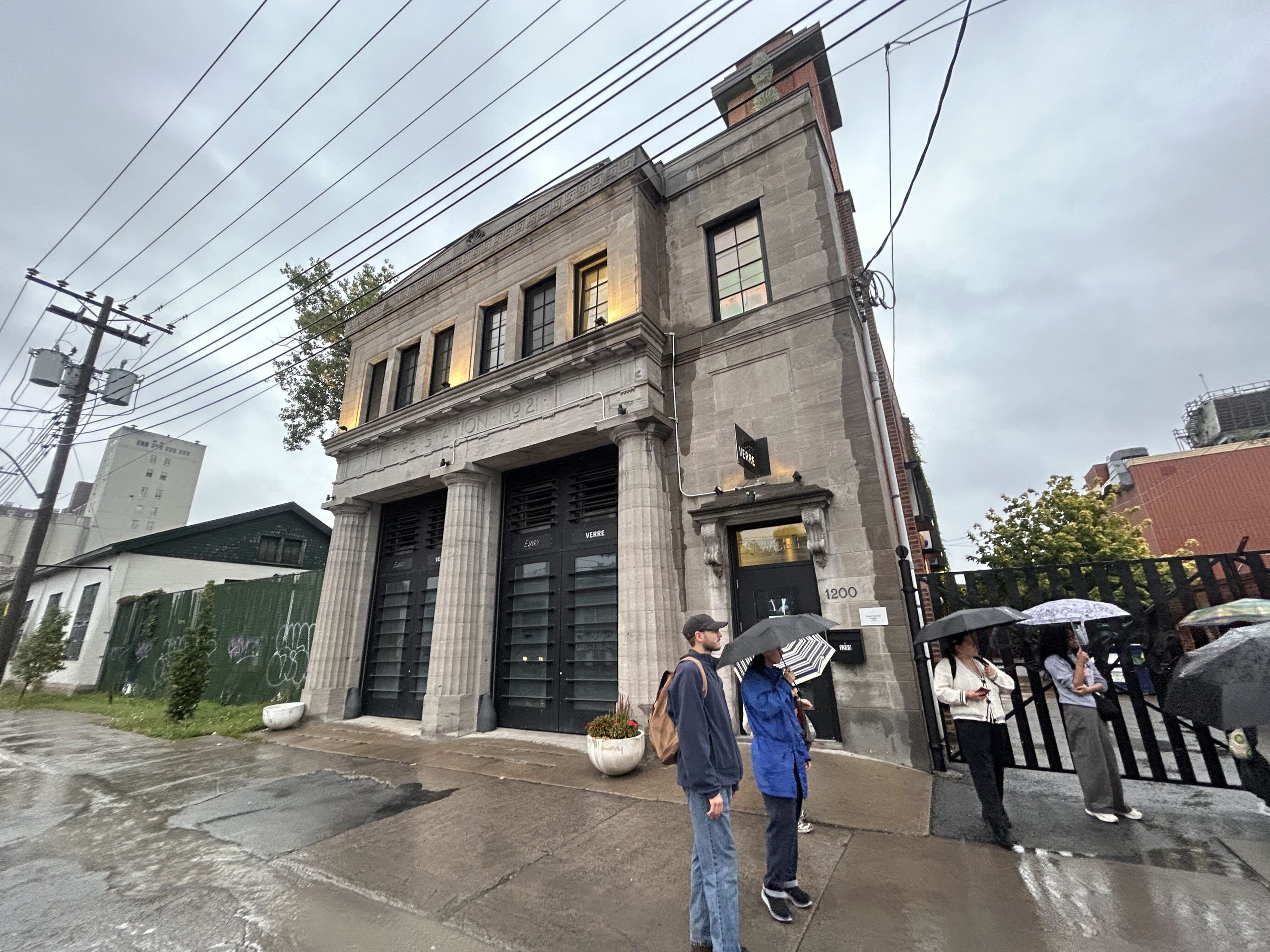
In response to this context, CoRe asked participating teams to work on four buildings in the Fine Craft and Artisan Trades District project. Teams could choose to work on one or more buildings, giving them greater flexibility in defining their program. Each building has features that could inform the proposals, which could also include extensions and new construction. Although they date from different periods, these buildings form an ensemble of industrial typology that the proposed interventions had to take into account from a heritage perspective.
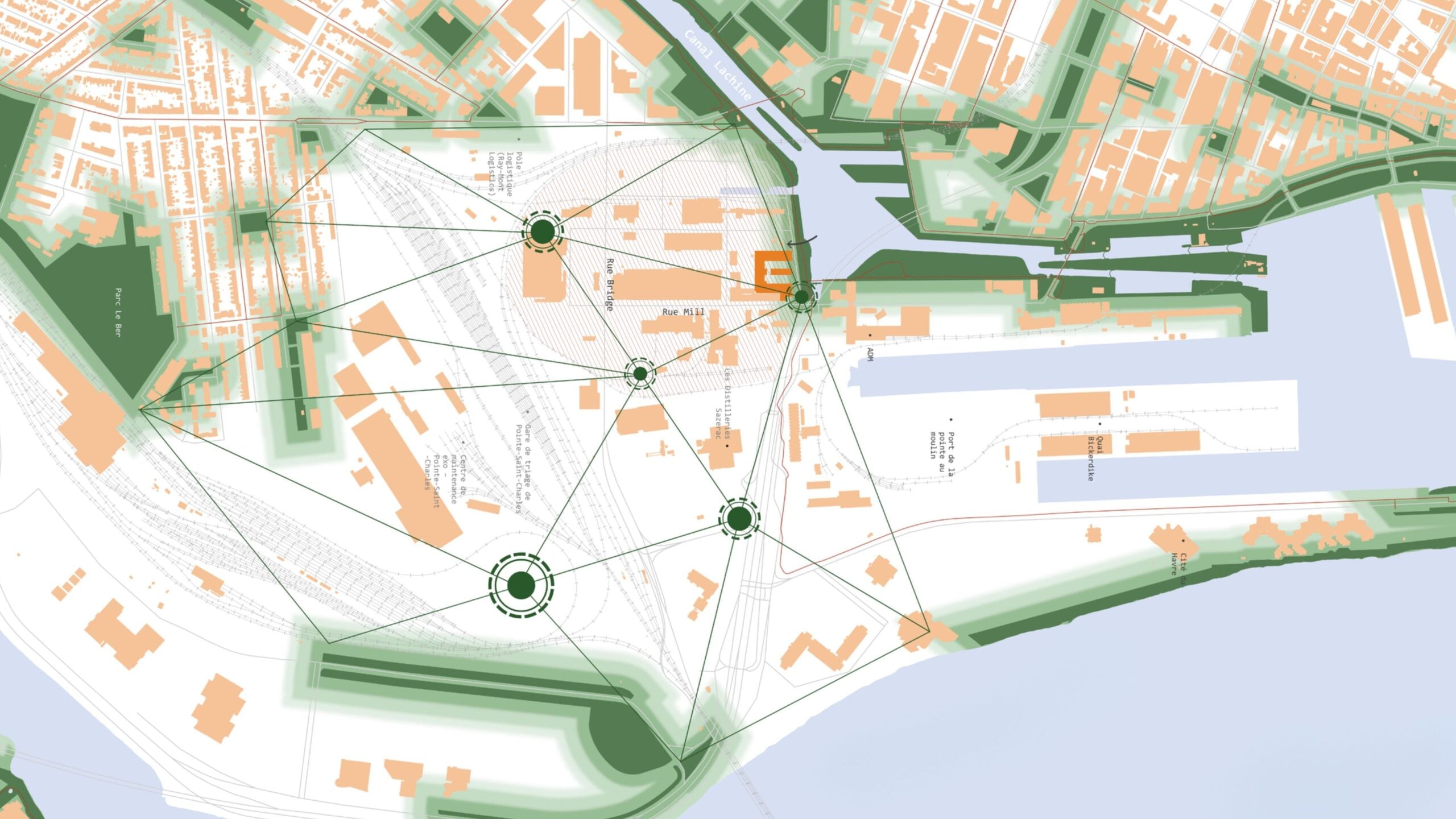
Participating teams had to consider three scales of intervention: the building, the neighbourhood and the territory. At the neighbourhood scale, the goal was to take surrounding buildings into account in order to create links between the proposed interventions and the Fine Craft and Artisan Trades District.
At the territorial scale, the reflection focused on the Bridge-Bonaventure sector and the barriers that surround it, including the Lachine Canal, the elevated Autoroute 10 and the Canadian National rail line. The sector’s urban fabric combines residential, low-density commercial and industrial uses.
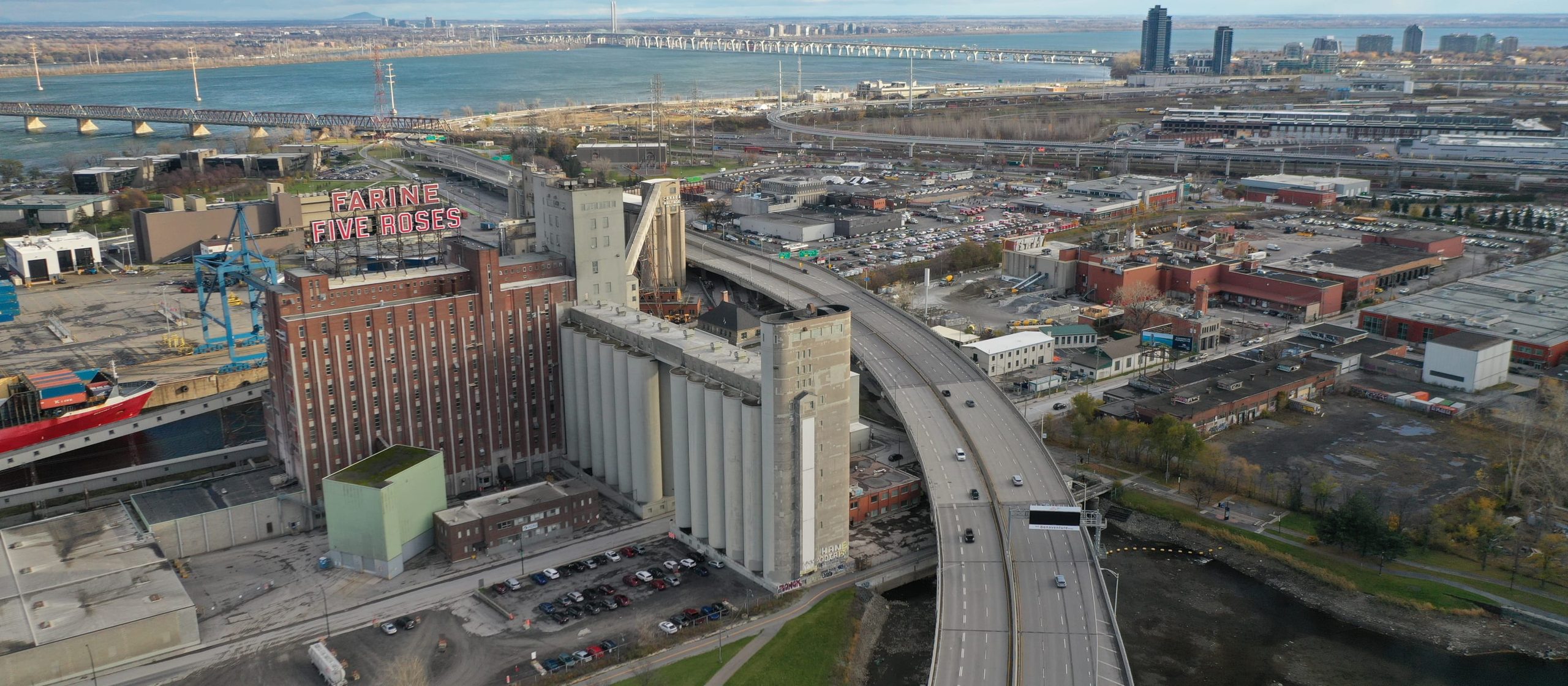
However, real estate pressure is being felt and is threatening the future of industrial activities. It was in this context that the charrette invited participating teams to reflect on the development of the Fine Craft and Artisan Trades District.
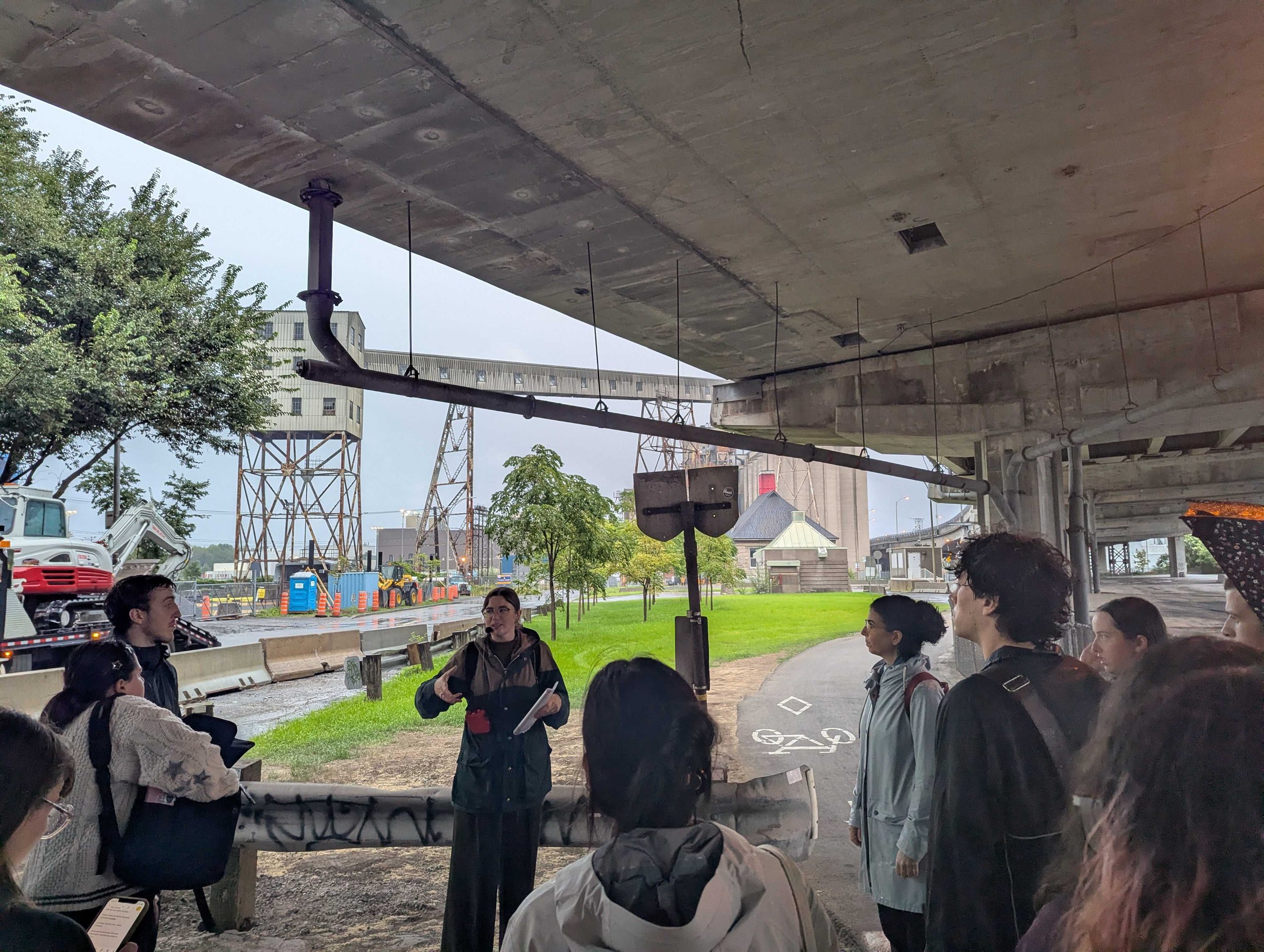
About 15 participants braved the rain on September 9, 2026, to take part in a guided walk through the Bridge-Bonaventure sector with Catherine Charron, then project manager for the CMAQ’s Fine Craft and Artisan Trades District. The tour allowed them to learn more about the buildings proposed for the charrette and about the challenges facing artisans.
In all, seven submissions were received. Given the scope of the work and the limited time available to produce the documents, they reflect the rigour and commitment of the next generation. The teams explored different avenues to address the constraints set out: phytoremediation of contaminated soil, neighbourhood identity, environmental issues related to reuse and repurposing, and ways to draw the public to the redeveloped sites.
Awards
First jury prize: Le berceau des métiers (Pierre-Luc Gingras)
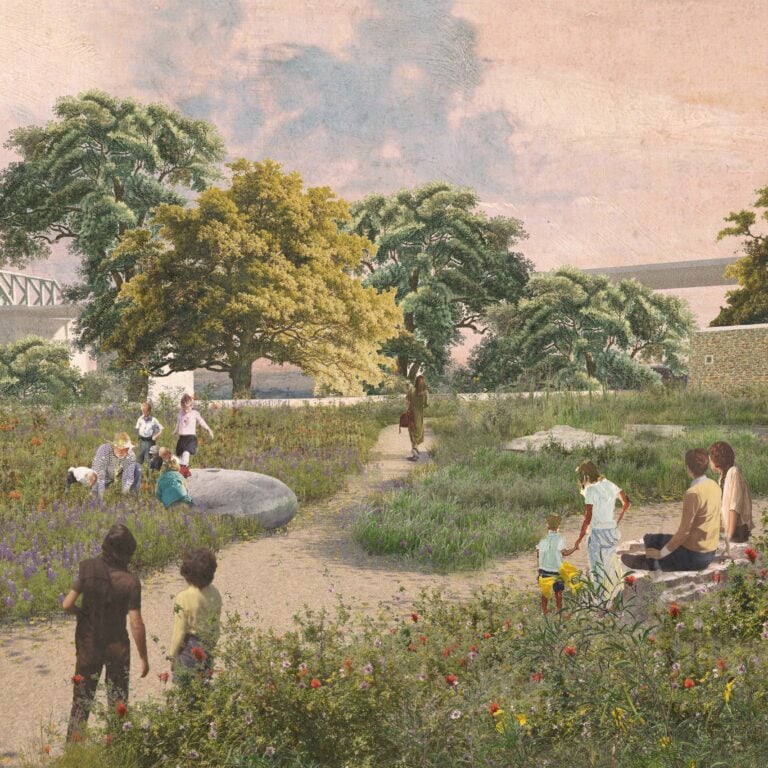
The project emphasizes the site’s connectivity and adaptability in order to open up the sector. It proposes extending the road network from rue Mill and rue Oak, along with new buildings connected to the existing building to allow it to be expanded gradually.
The sustained reflection on various aspects of the project earned the submission the jury’s attention, first and foremost through a site layout that is well balanced at the scale of the existing neighbourhood. The jury also noted the relevance of the project’s phasing on the site, as well as the attention paid to showcasing the dry docks and to the significant traffic issues around the site. The jury noted several advantages of the massing concentrated along rue Mill: a screen against noise pollution, protection for the interior courtyards and natural sunlight preserved on the lot. The jury would have liked to get a better sense of the project’s materiality and atmospheres, but found that the aspects of the submission that were developed are well resolved and rooted in the neighbourhood.
Jury’s comments
Second jury prize: Le secteur Bridge-Bonaventure (Quentin Hocquinghem, Francis-Olivier Charbonneau and Orianne Fauré)
The team’s submission calls for new signage at the entrance to the sector to mark its boundaries and draw the public. The project then brings artisans together in a large shared hall and relies on a route punctuated by points of interest to raise public awareness and encourage exchanges with artisans.
The jury appreciated the restraint of the submission, which relies on reinterpreting the site through the lens of events, making it a simple and affordable project to implement. Among the presentation’s main strengths are its affirmation of the neighbourhood’s identity as a gathering place and potential tourist hub—a dimension unique to this submission—and the design of the new fine craft building, modelled on a large market hall. However, the development of the layout, the building’s configuration and its integration into the existing context still need refinement.
Jury’s comments
Special jury mention: L’Éducation… (Henri Bazinet, Maria Moreno Ramirez and Chloé Thouny)
The project includes a secondary school and various spaces dedicated to teaching and sharing know-how, both theoretical and practical. Multi-purpose workshops are integrated into a cross-disciplinary knowledge campus that serves the sector and connects to other nearby educational institutions.
This submission earned the jury’s special mention as a personal favourite for its strong stance: focusing on passing on know-how through education. The jury appreciated the links with nearby educational institutions. The proposed program—school, materials library, ecocentre—makes it a meaningful project geared to society’s needs.
Jury’s comments
However, the interventions at the neighbourhood and building scales remain too schematic, and the depiction of the neighbourhood is not always true to reality. The program, which is more public-oriented, could increase traffic in the sector and limits the space given to artisans. L’Éducation… nonetheless remains a theoretical project of remarkable elegance.
People’s choice award: La bohème industrielle (Géraldine Coquillat and Maéva Ramboni)
In addition to the jury prizes, the public was invited to vote for its favourite submission from September 23 to 30, 2026: 427 votes were cast. La bohème industrielle received 33.5% of the votes. It proposes a creative hub and a microbrewery, as well as temporary seasonal installations.
Time to hang up the tools?
Deindustrialization is affecting many cities and regions around the world. In particular, financial pressures on premises and workshops are forcing artisans to move or close up shop. The CMAQ’s initiative shows, however, that industrial redevelopment remains relevant despite the obstacles. Manual work thus continues to shape part of Montréal’s identity in the 21st century.
We would like to thank all the participants for making this fourth edition possible and creative!
With the support of the Conseil des métiers d’art du Québec, Sid Lee Architecture, HUMÀ DESIGN + ARCHITECTURE and John Diodati.
Special thanks to Espace Ville Autrement and to Gabriel Laferrière of Passerelles Coopérative en patrimoine for hosting the awards ceremony!
Media partner: Kollectif
The submissions were evaluated by the following jury members:
- Catherine Charron, former architecture and heritage manager and coordinator of the Fine Craft and Artisan Trades District at the Conseil des métiers d’art du Québec (CMAQ)
- Alexandre Maquet, stonecutter at Créa-Pierre
- Mathieu Payette-Hamelin, head of the Heritage Division at the City of Montréal
- Alexandre Petitpas, project manager for built and landscape heritage at L’ENCLUME
- Keyan Ye, self-employed architect
- Angelica Perazza Martinez, architect and member of Pivot, coopérative d’architecture
About the partners
Héritage Montréal’s Next Generation Committee (CoRe)
Founded in 2016, Héritage Montréal’s Next Generation Committee aims to bring heritage to life in new ways. A true laboratory for exploration, it offers alternative activities for discovering or rediscovering heritage. Its mission is to develop new avenues for raising awareness, communicating and engaging with emerging professionals in architecture, urban planning, heritage and design who are interested in Montréal’s built heritage. In doing so, it seeks to increase opportunities for collaboration and to facilitate the sharing of diverse experiences and career paths. Made up of about 10 volunteer members, the Next Generation Committee organizes events—tours, exhibitions, film screenings and discussions, and more—to explore Montréal’s heritage from a playful, original and engaged perspective.
Conseil des métiers d’art du Québec (CMAQ)
For more than 30 years, the Conseil des métiers d’art du Québec (CMAQ) has worked to represent, support and develop the field of fine craft in Quebec. Recognized under the Act respecting the professional status of artists in the visual arts, film, the recording arts, literature, arts and crafts and the performing arts (chapter S-32.1), the CMAQ brings together and represents professional craftspeople, and supports their professional development as well as the presentation and marketing of their work. To that end, it works with the entire fine craft ecosystem in Quebec and Canada. The CMAQ was formed through the merger of two associations, the Corporation des artisanes et artisans de Québec (Quebec City) and Métiers d’art du Québec (Montréal), becoming the only association recognized to represent the field as a whole. Since its creation, it has pursued the objectives of promoting and defending the moral and socio-economic interests of craftspeople, promoting excellence in fine craft and raising the profile of fine craft creations, and professionalizing practices in the field. With its partners—government and institutional organizations, regional associations, workshop-schools, presenters and others—it helps renew creative approaches in fine craft.