November 8 is World Town Planning Day. Established in 1949 following a proposal by an Argentine academic, the day is an opportunity to recognize the contribution of urban and regional planning, and the professionals working in these fields, to the well-being and harmonious, sustainable development of communities.
Since 2013, it has been preceded on October 31 by World Cities Day, proclaimed by the United Nations. For Montreal, the Montreal Metropolitan Community and Quebec, World Town Planning Day is an opportunity to highlight the importance of planning processes and tools such as the Plan d’urbanisme et de mobilité (PUM), adopted by Montreal City Council in June 2025, the Plan métropolitain d’aménagement et de développement (PMAD), and policies such as the Politique nationale d’architecture et d’aménagement du territoire (PNAAT), adopted by the Quebec government in 2022. While it is easy to get lost in these acronyms and, more importantly, all too common to confuse planning with bureaucracy, we are seeing a growing number of special powers and other mechanisms designed to fast-track real estate projects by reducing or bypassing public consultation requirements or professional planning teams. World Town Planning Day reminds us that these processes, however imperfect, remain essential to avoiding the urban planning mistakes of the 1960s and 1970s.
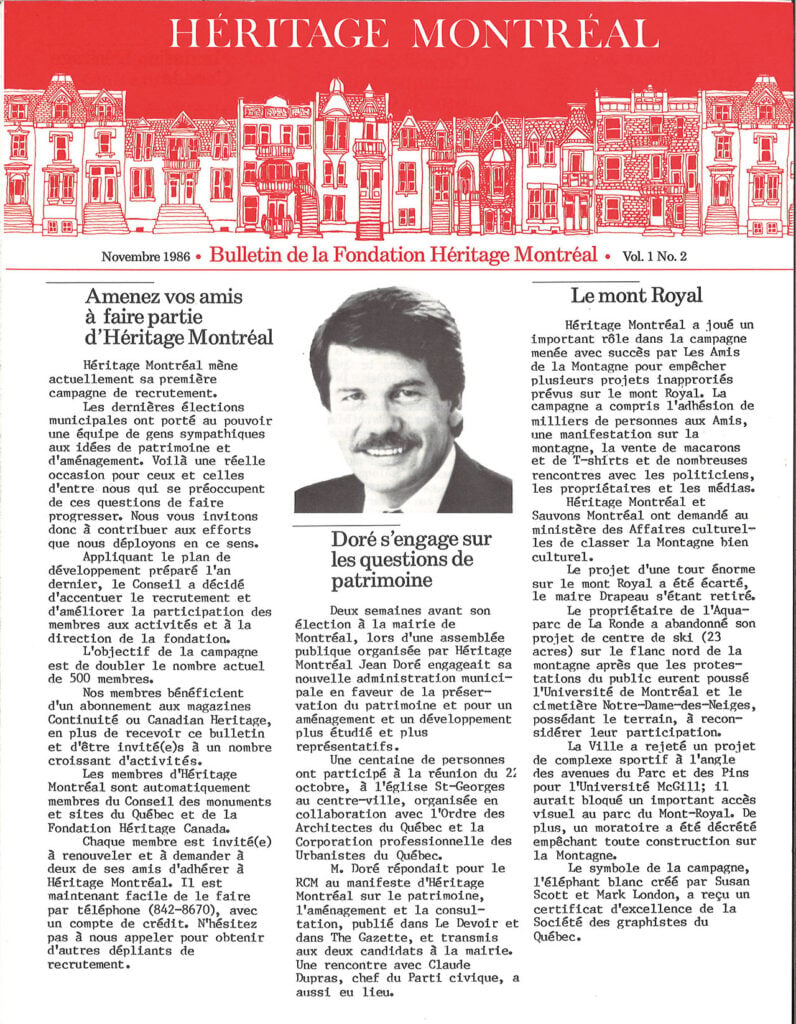
November 9 also marks a pivotal moment in Montreal’s history, as we celebrate the 40th anniversary of the election of the Montreal Citizens’ Movement (MCM) to City Hall. Jean Doré succeeded Jean Drapeau following an election campaign shaped by debates over urban planning, housing and heritage, particularly in the wake of proposals for a shopping centre on McGill College Avenue and a tower on Mount Royal.
The election of the MCM marked the beginning of a modern revolution in Montreal. The new administration quickly embarked on the ambitious task of developing the city’s first-ever urban plan. Developed through years of work and public consultation, notably under the leadership of the late André Lavallée, the plan was adopted in 1992 and remains one of the major legacies of Montreal’s 350th anniversary. Breaking away from cold, functionalist urban planning, it was grounded in Montréal’s distinctive identity and its actual urban fabric: a city that is lived in, inhabited and democratic. Fundamental to Montreal’s coherent development, the plan would go on to inspire other major cities, including Sydney, Australia.
The MCM administration also established a special advisory commission on the preservation of built heritage. Chaired by Hubert Simard and including Héritage Montréal’s executive director, the late Mark London, among its members, the commission published an important report in May 1987, whose recommendations helped modernize Montreal’s approach to heritage conservation.
Beginning in 1986, Jean Doré led a revolution in Montreal that can only be compared to the Quiet Revolution of the 1960s. I find it difficult to think of any current projects that were not initiated by Jean Doré (…) He established our right to Montreal.
Phyllis Lambert, June 2015, following the death of Jean Doré. Quoted by Jean-Robert Choquet.
Democratizing urban planning and development also requires public, independent and credible processes to hear and understand different perspectives and identify areas of consensus or possible solutions. The arrival of the MCM administration thus marked the beginning of structured public consultations in Montreal. Drawing inspiration from the work of the Bureau d’audiences publiques sur l’environnement (BAPE), as well as consultations on the Old Port and McGill College Avenue and community-led initiatives, notably in Rosemont, the City of Montreal’s first public consultation concerned a cultural project involving heritage: the expansion of the Montreal Museum of Fine Arts on Sherbrooke Street. The hearings, held in the former Erskine and American Church, attracted considerable public interest.
Heritage, urban planning and public consultation are closely interconnected. All three require a commitment from elected officials that has not always been forthcoming over the past 50 years. All the more reason to celebrate both World Town Planning Day and the 40th anniversary of the MCM’s election. These anniversaries invite us to reflect on the progress achieved and the challenges we face today, including the temptation to wipe the slate clean and move backwards, rather than finding ways to improve procedures while strengthening their objectives.